Showing posts with label fish. Show all posts

Friday, May 11, 2012

Fish Fossil...Alive Today?

0 comments


For years and years the scientist have confirmed that the dinosaurs and their habitats, and whatever that lived within their time, are all finished, and what's left is their fossils. Now, this fish was thought to have been extinct since the end of the cretaceous period over 65 million years ago. Fossils of the coelacanth have been found that date back over 350 million years. At this time, scientists believe that no such fish still roam the deep of the sea.


Then, not long ago, a fisherman accidentally caught a live coelacanth off the coast of Africa in 1938. A second specimen was caught in 1952 off the coast of Comoros Islands near Madagascar. Scientists were baffled. A fish fossil, alive and roaming the sea near Africa? The matter was not left untended. A research party was formed, and they find that this 'Dinofish' has a lot of tale to tell. Especially when these scientists think that the coelacanth is the step of fish evolutioning into amphibians. 


The most striking feature of this "living fossil" is its paired lobe fins that extend away from its body like legs and move in an alternating pattern, like a trotting horse. Other unique characteristics include a hinged joint in the skull which allows the fish to widen its mouth for large prey; an oil-filled tube, called a notochord, which serves as a backbone; thick scales common only to extinct fish, and an electrosensory rostral organ in its snout likely used to detect prey.


      Ceolacanths are opportunistic feeders, eating just about anything they can find and fit in their mouth. They possess hinges in their skulls that allow them to consume very large prey. Their diet is believed to consist mainly of squid, eels, small sharks, and other animals that are found in their deep sea habitats. They hunt their prey near deep underwater volcanic slopes and can frequently be seen swimming with their heads down. They have even been seen swimming upside down and backwards. Researchers believe that this behavior allows them to use a special organ called a rostral gland to help them locate their prey. Once located, their meal is usually swallowed whole. Since food can be scarce at these great depths, scientists believe that the coelacanth has the ability to slow down its metabolism. This allows the fish to go for long periods of time without eating. This may be part of the reason they have survived so long and outlived their other prehistoric cousins. In their natural habitat, they are believed to live about 60 years. 


Reproduction

Coelacanths give birth to live young, known as "pups". There are usually between 5 and 25 pups born at any given time. These young coelacanth pups are fully formed and capable of surviving on their own as soon as they are born. Their gestation time is 13 months, and it is believed that ceolacanths are unable to reproduce until they are 20 years old. Beyond that, very little is known about the reproductive habits of this elusive creature.

Dwellings

Coelacanths can be found throughout the Indian ocean, from the southwest coast of Africa to Indonesia. They can to go as deep as 2,300 feet (700 meters), but are more commonly found at a depth of 300 - 600 feet (90 - 200 meters). Because of their sensitive eyes, these fish prefer the darkness. They are rarely ever seen during the daytime hours or on nights with a full moon. They prefer cold water because their gills have trouble absorbing oxygen in warm water. In Sodwana Bay, South Africa, coelacanths have been found resting in caves during the day.
In 1989, the coelacanth was declared an endangered species by the international community. Their current world population is believed to be fewer than 500 animals. This means that without protection, this prehistoric animal that has survived for over 350 million years could be wiped out in our lifetime.


For more information, visit Dinofish.com
Read more ...

Tuesday, May 8, 2012

World's Most 'Miserable-looking' fish...

0 comments
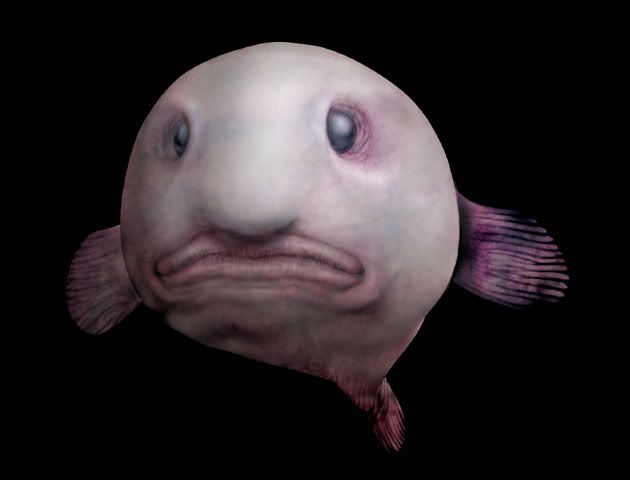
Ever heard of a fish looking so miserable? Or even possible, 'human-like'? No? Then you're about to witness a great discovery of a fish with both characteristics,(It's not my discovery,sorry) which has earned this species as the World's Most 'Miserable-looking' Fish! Known to the few who knew of it's existence as the 'Blob fish', it is one of God's bizarre creation...

According to New Straits Times-School Times the blob fish is a rarely seen creature dwelling off the coast of Australian and Tasmania. Why is it rarely seen?

Simple, it is because this fish lives at the bottom of the ocean, around 800 metres deep and the pressure at this depth is 80 times higher than it is at sea level, which is obvious why not many has spotted it before. And most fishes cannot withstand the pressure either. But how does this fish survive at such high pressures?

As I say earlier, this is another of God's bizarre creation. The blob fish body is made up almost entirely of a gelatinous substance, which keeps it from sinking completely since the density of the goo is slightly lower than the density of water. Since the blob fish is mostly muscle, it typically spends its time floating in the same spot, waiting for its next meal to come by. According to scientists, the blob fish has a diet of sea urchins and molluscs, which are highly edible there, and doesn't exert too much effort to capture its prey. Hence, it does not have frequent meals. But this works fine as it does not require a lot of food. It devotes most of its time remaining stationary. Because of this strange behaviour, researches has dubbed it lazy.
How does this fish reproduce???
Well now, that is an interesting question, but as far as I've searched (which is not much but I'll try later), there's no mention on how they reproduce. But I've come across this in the same newspaper, and it says that the female lays thousands of eggs at one go and unlike many other fishes, she will actually stay with the eggs, floating above them and, in some cases, even sitting directly on top of them. The blob fish is known for its nesting habits. It is therefore, unknown, whether this nesting behaviour is for strategic purposes or simply as a result of its 'lazy' nature.

Fun Facts!

When underwater, the blob fish has an almost human and comical face (above pic). This appearance changes if it is taken out of the water, even for a short while. It's gelatinous body will dry out and shrivel. (pic below)


Currently, the blob fish's survival has become a concern, because it is becoming more common for fisherman to accidentally capture it while fishing. It is often being dragged up with the other catches by trawler fishermen. Marine expert Professor Callum Roberts from University of York said "The blob fish had plenty to be miserable about, as they are only restricted to these waters." 
Read more ...